Travel Trends
Coolcations for Summer 2027: Why the Map Stopped Working
Denmark set an all-time national heat record last June while parts of northern Norway ran cold and soaked, so here is how to pick a summer 2027 base on something sturdier than a line of latitude.
The coolcation pitch was simple, and for two summers it mostly worked. Go north, go up, skip the worst of it. Book Copenhagen instead of Rome, the Highlands instead of the Amalfi Coast, and let everyone else queue in the sun.
Then last June, Denmark hit 98.6°F. Not warm for Denmark. An all-time national record, 37.0°C, set at Ødum and Beldringe on June 27, breaking a mark that had stood since 1975 in a series that goes back to 1874. England set a June record of 99.9°F. Wales set one at 96.6°F and got its first ever national red extreme heat warning. Germany saw 252 stations set all-time records in a single week. Meanwhile, 1,200 miles north, Troms and Nordland spent July cold and wet enough that Lurøy logged 349.7 mm of rain, nearly double its normal and the wettest station in the country. Both of those things happened in the same summer, in the same part of the world, in what people were calling the cool half of Europe. That is the whole lesson, and it is worth more than any list of destinations.The Quick Take
What actually changed, and what it means for your 2027 planning
- “North” stopped being a reliable proxy for cool. Denmark broke its all-time record while northern Norway ran below normal. Latitude alone is not a plan.
- Three variables still work: altitude, exposure to open water, and whether the building you sleep in can actually cool itself.
- The Mediterranean never emptied out. Greece posted its best visitor year ever. The coolcation trend moved money north without moving it out of the south.
- The north now costs more and taxes more. Edinburgh’s 5% visitor levy went live in July. Norway’s 3% levy is rolling out by municipality. Wales starts April 2027.
- Timing beats geography. September in Europe is closing fast on August, and it is the single most underused move on the board.
What last summer actually settled
Western Europe recorded its warmest June on record, averaging 3.06°C above the 1991 to 2020 baseline. Taken together, June and July 2026 were the hottest such pair Europe has ever measured. There were four separate heatwaves between late May and August. The effects were not subtle. The Eiffel Tower and the Louvre announced early closures. The Uffizi in Florence stopped selling tickets when its air conditioning failed. Eurostar suspended London to Paris service on the worst days and SNCF
71 intercity trains. In the Alps, Swiss glaciers lost more than four meters of ice in a single month, melting at roughly ten centimeters a day.
And then the part that does not belong in a travel brochure but belongs in an honest one. Provisional national counts compiled across Europe put excess deaths from those four heatwaves at 35,000 or more. The methodologies differ country to country and the figures will be revised. The direction will not.
I am not telling you this to talk you out of Europe in summer. I am telling you because it changes what a good itinerary looks like, and because the people most affected by heat are older travelers, which describes a great many of the people I plan for and, on a bad afternoon in July, describes me.

The one place the premise held, and why
Northern Norway did deliver. Troms and southern Nordland ran cold and very wet through July, and the mountain stations above Senja and Narvik were among the coldest in the country. But look one region further and the story flips. Northern Finnmark, further north still, was classified very warm that same month. Svalbard set a new July record for high monthly mean temperature at Sørkappøya, in a record series that starts in 1908. Norway as a whole finished the month one tenth of a degree below normal. One country. One month. Record wet and cold in one region, record warmth in another, and a national average that looked entirely ordinary. If a single country cannot be summarized by its latitude, a continent certainly cannot. Which means the useful question was never “where is the cool place.” It is “what makes a specific place cool, and does it still apply in the third week of July.”
Latitude is a headline. Altitude, open water, and a building that can cool itself are the things that decide whether you sleep.
Lauren Cardinale, Founder
The three variables that make a coolcation actually work
1. Altitude, which is physics
Air cools roughly three and a half degrees Fahrenheit for every thousand feet you climb. A base at 5,000 feet in the Dolomites or the Bernese Oberland sits in a different climate from a valley town thirty miles away and 4,000 feet below it. This is the most dependable lever there is, and it is why the Alps and the Dolomites held up in 2026 for people staying high even as Basel hit its hottest June temperature on record. The trap is day trips. Sleeping at altitude and spending every afternoon down in the valley gives you the heat and the drive time both.2. Exposure to open water
Large bodies of water are slow to warm and slow to release, so coastlines facing open ocean hold a narrower temperature range than inland basins do. West-facing Ireland, the Scottish islands, the Norwegian coast, and the Atlantic edge of Brittany all behave this way. Denmark is instructive here as a counterexample. It looks maritime on a map, but it sits where continental air masses arrive, and last June one of them did.3. Whether the building can cool itself
This is the variable almost nobody checks, and it is the one that ruins trips. A great many of the most beautiful hotels in cool northern Europe were built in an era that did not need cooling, and a meaningful number of them still have none. A 1910 grand hotel with 14 foot ceilings, west-facing windows and no air conditioning is a spectacular place to have lunch and a difficult place to sleep in a heat event. Ask before you book, not after. Ask specifically: is there air conditioning in the guest rooms, is it in every room or only some categories, and does it work at night. The answers vary within a single property, and the front desk will tell you honestly if the question is asked plainly.
The north is not the bargain it was
Three things happened at once. Demand moved north, prices followed, and the destinations started charging for the privilege.- Edinburgh now applies a 5% visitor levy on accommodation, capped at five consecutive nights. It took effect July 24, 2026 and is Scotland’s first.
- Norway has legislated a 3% visitor levy covering overnight stays and cruise passengers, adopted municipality by municipality rather than nationally.
- Wales starts its levy no earlier than April 1, 2027, at £1.30 per person per night for hotels and self-catering.
- The Dolomites now gate their signature sites. Lake Braies requires an advance vehicle reservation to drive in between July 1 and September 15.

The move almost nobody is making
Change the month instead of the map. September in Europe has been quietly closing on August. In the luxury segment it has gone from 79% of August’s booking volume to 92% in two years, and fall bookings overall are up sharply. The reason is not complicated. You get the Mediterranean at 78°F instead of 98°F, the sea is at its warmest of the year, the harvest is happening, the crowds have gone back to school, and the rates soften. If your calendar allows it, moving a Greece or Italy or southern France trip from late July to the second week of September solves more problems than relocating that trip to Norway does, and it costs less. If your calendar does not allow it, because you travel around a school year, then altitude and open water are your levers and you should use them deliberately.What is opening, and what you can actually get to
New rooms worth knowing about
- The Park Gstaad, a Four Seasons Hotel is scheduled to open in the Bernese Oberland in mid-summer 2027, with 75 rooms and suites in a restored 1910 building.
- Mandarin Oriental Cristallo in Cortina d’Ampezzo now shows an early 2027 opening on the brand’s own page, having slipped past the February 2026 Olympics.
- Six Senses Milan is listed for 2027, which matters mostly as a front or back end for the Dolomites and the lakes.
Getting there
United announced its largest international expansion in August 2026, and two routes matter here: Washington Dulles to Milan Malpensa three times weekly from May 28, 2027, and Newark to Ljubljana four times weekly from May 12, 2027. Both open the Alps and the Dolomites from the East Coast without a European connection. What did not happen is just as useful to know. No US carrier added a new nonstop to Oslo, Bergen, Stockholm or Copenhagen for 2027. United looked at it publicly and passed. Getting to the fjords still means connecting through Frankfurt, Munich, Zurich or Copenhagen, so build the day around one long connection rather than two tight ones. On rails, a night train now runs from Amsterdam and Brussels to Milan three times a week, which is a genuinely lovely way to arrive in the lakes.On the water
Arctic and Northern Europe expedition capacity for 2027 is expanding across several luxury operators, with Iceland, Greenland, Svalbard, the Norwegian fjords and the British Isles all on sale. The structural change worth noting is that Greenland itineraries are getting shorter and departing from more places, which lowers the barrier if a fourteen day polar commitment was the thing stopping you.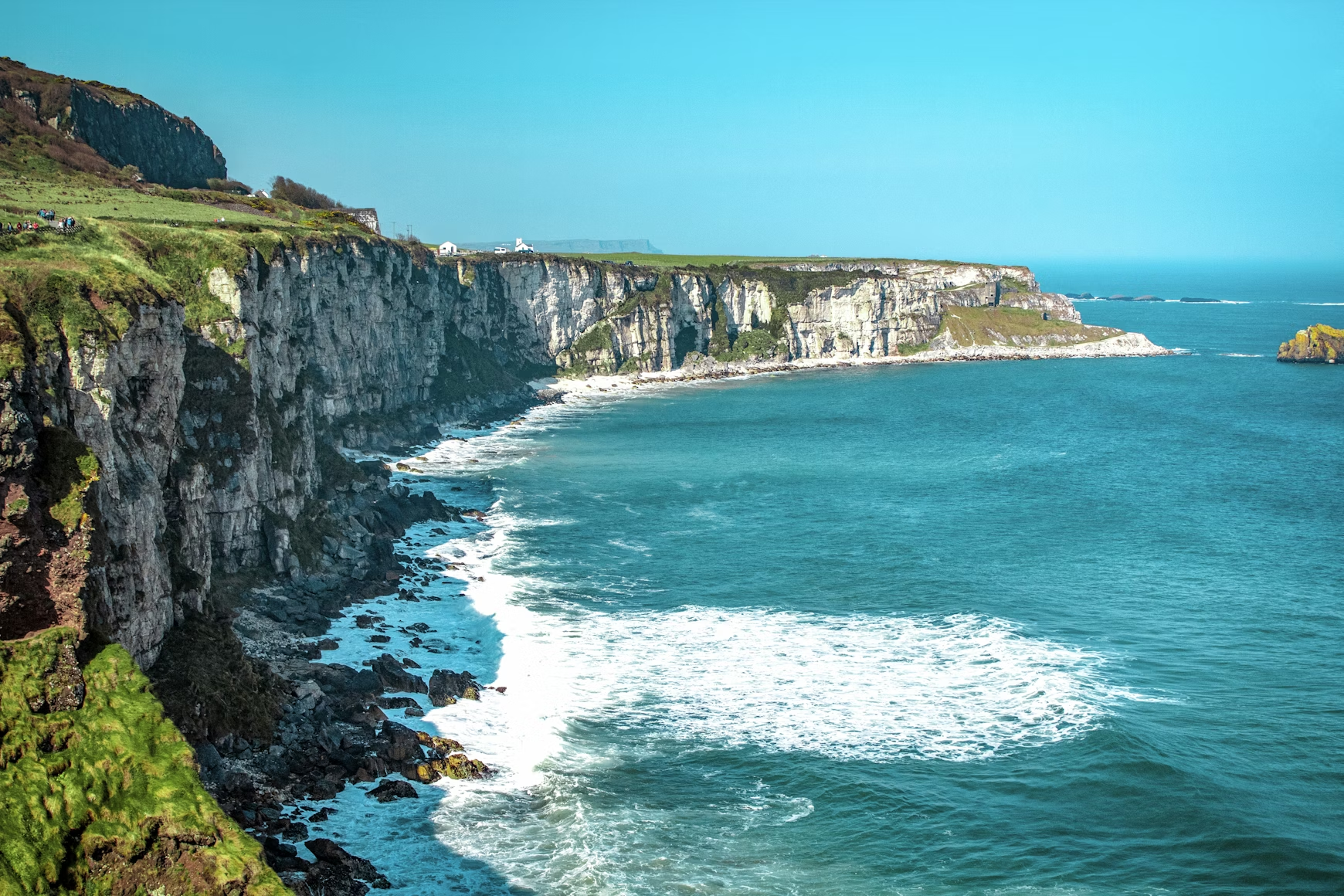
Europe
France, Italy, Greece, Türkiye, the UK and Ireland
Where the altitude, the coastline and the September light all live. Start here if summer 2027 is going to be a European summer. Explore Europe →
By Water
Cruises & River Journeys
The fjords, Iceland, Greenland and the British Isles, plus the river routes that let you unpack once and still move. Explore Cruises & River Journeys →
When to book, honestly
Earlier than you want to hear. Across the luxury market, forward bookings for trips one and two years out are up 50%, and bookings of $50,000 and above are up 47%. Summer Europe hotel sales rose 31% year over year on a 15% increase in rates. Advance rooms at the properties worth wanting are being taken now. For summer 2027, that means the window for a specific hotel, a specific suite category, or anything involving connecting rooms and a
group is roughly now through this fall. If you are flexible on property, you have longer. If you have a particular place in mind, you do not.
Two practical notes that sit outside this piece. Entry rules changed this year and the first day of a European trip now takes longer than it used to, which I covered separately in Europe Entry Requirements for 2027. And the one thing I would not do is wait for the weather forecast. There is no version of this where you know in March what the third week of July looks like. What you can control is the altitude, the water, the building and the month. Those four decide whether a July afternoon is something you enjoy or something you wait out. That is the whole job.
Let’s plan it properly
Want a summer 2027 trip that holds up in a heat wave?
Tell me the dates you are locked into and who is traveling. I will come back with two or three routings built around real cooling and real timing, with the altitude, the water and the air conditioning already checked, plus what each one costs before you commit to anything. Start with a call
Written by
Lauren Cardinale
Founder of Travel Design Co., based in New Orleans, designing trips since 2013.Condé Nast Top Travel SpecialistASTA Verified AdvisorSignature Travel Expert SelectTripAdvisor Reco Founding Advisor