River Cruise, Designed Around You: The Luxury Add-Ons That Make It Seamless
The five decisions that turn a packaged sailing into a trip built around your pace, and the one risk nobody puts in the brochure.
River cruising is having a moment, and the reasons are easy to see. You unpack once. You wake up somewhere new. The ship ties up in the middle of town instead of an industrial port forty minutes out, and you walk off into the place itself.
Here is what we notice, though. The travelers who come back from a river cruise saying it was the best trip they have taken are almost never the ones who booked the package as it came. They are the ones who treated the sailing as the spine of the trip and then built the rest of it around themselves.
That is the whole difference. Not a bigger cabin. The nights on either end, the two or three experiences you privatize instead of ten, and the transfers that mean you are never standing in a lobby at 5:40 in the morning wondering where the car is.
Five decisions that make a river cruise feel designed around you
- Start with the itinerary, not the ship. The route decides what your days feel like. The brand decides what your dinner looks like.
- Add one to two nights before you board. You arrive rested and you get the embarkation city properly instead of through a jet-lag haze.
- Privatize two or three moments, not everything. Depth in a few ports beats a guide following you around for eight days.
- Buy the transfers. The in-between is where a trip quietly falls apart, and it is the cheapest thing to fix.
- End with a finale, not an airport. Two to four nights after you disembark changes how the whole trip reads in memory.

Why river cruising keeps winning people over
It solves a set of problems that luxury land travel does not always solve.
- Ease. One unpack. No 6 a.m. hotel changes, no luggage in and out of cars for eight days straight.
- Access. Ports sit in the center of town. You step off the ship and you are already there.
- Pacing. A morning out, an afternoon on deck, and the ship moves while you are at dinner.
- Inclusions. Meals, most excursions, and the moving between places are already handled.
It is a particularly good fit for two groups we work with constantly. Empty nesters who want a trip that is social when they feel like it and quiet when they do not. And multi-generational families, where the ship does the hard job of keeping four different energy levels in the same place without anyone feeling managed.
What a designed river cruise actually means
The standard approach is: fly in, board, sail, fly home. It works. It is also indistinguishable from what the couple in the next cabin booked.
The designed approach is the same sailing with five decisions made deliberately.
- The right itinerary, chosen before the ship
- Cabin category selected for how you actually use a room
- Pre and post stays that extend the route instead of bookending it randomly
- Private experiences placed where depth pays off
- Every transition handled before you leave home
Lauren Cardinale, Founder
Step 1: Choose the itinerary first, then the ship
It is tempting to start with the brand, because that is what the advertising is about. But the route is what shapes your days, and two ships on the same river can deliver completely different weeks.
What we look at
- Port intensity. How many stops, and how much genuine downtime between them. Some itineraries are a stop a day for eight days. That is a lot if you wanted rest.
- Town mix. Capitals or villages. Most people think they want capitals and then remember the small towns.
- Season. Weather, crowd levels, water conditions, and whether a festival or market season is the point or the problem.
- What you are actually interested in. Wine, art, food, history, Christmas markets. These are different trips on the same river.
If you are still deciding between rivers and regions, our Cruises & River Journeys page is the place to start. It lays out the routes and the ship partners we work with most and why.

Step 2: Build a pre-cruise stay that sets the tone
A pre-cruise stay is not a buffer. It is the part of the trip that decides whether you board rested or wrecked.
Why we push for it every time
- You absorb the flight before the itinerary starts moving without you
- You get a real city on a real schedule instead of a four-hour panoramic drive
- You can add the things the cruise line will never include
- If a bag goes missing, you have two days of runway instead of two hours
Pre-cruise stays we plan often
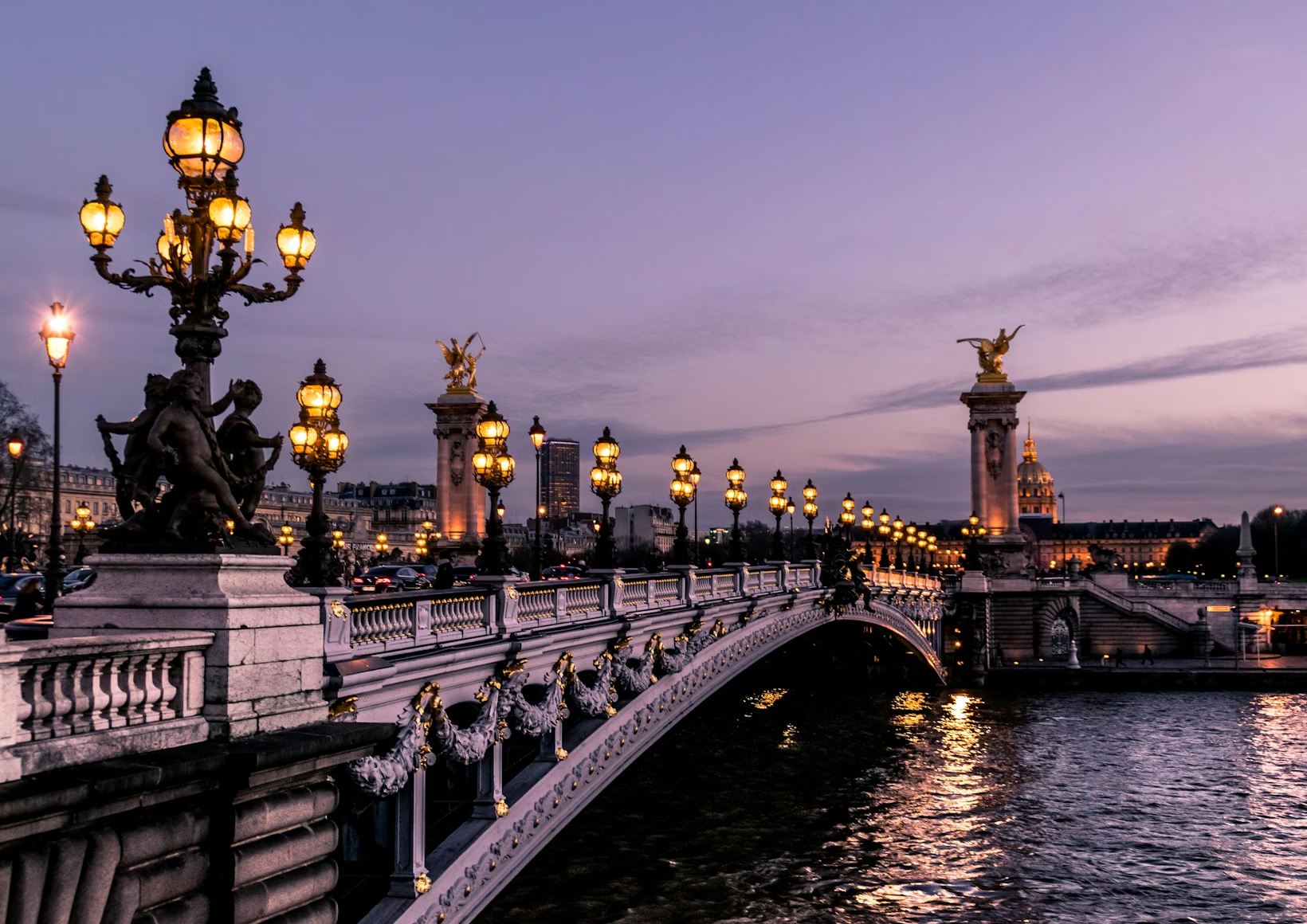
- Paris before the Seine. Museum time with a private guide who can get you in ahead of the room filling up, then an evening walking through one neighborhood eating your way along it.
- Amsterdam before the Rhine. A canal-side hotel small enough that they know your name by the second morning, and a day out to Haarlem or the countryside.
- Budapest before the Danube. A thermal bath in the morning before the crowds, and a chef-led walk through the market that ends with lunch.
Step 3: Add private experiences in one to three key ports
You do not need to privatize the whole sailing. Most people who try it end up over-scheduled and slightly exhausted by day five.
Pick the moments where a private guide genuinely changes what you see.
- A city where you want depth. Vienna, Budapest, and Strasbourg all reward a guide who can go past the highlight loop.
- A culinary experience in a wine region. A producer who does not take walk-ins, a cellar, a table, and a couple of hours that were not on any schedule.
- A driver and guide for a countryside day. The most valuable version of this is often the one where you skip the port entirely and drive inland.
The other half of this is knowing when to do nothing. A day with no plan, on deck, moving through a river gorge, is frequently the day people describe first when they get home.

Step 4: Make transfers and timing feel effortless
Luxury is won or lost in the in-between moments, and this is the cheapest part of the trip to get right.
- Private airport transfers. Particularly with real luggage, and particularly in cities where the taxi rank is a negotiation.
- VIP airport meet and greet. Worth it in the airports that are genuinely difficult, not everywhere.
- Hotel nights that match the flights. If a schedule requires a 5 a.m. departure, the answer is usually another night, not an earlier alarm.
- A number that answers. Somebody who is awake in your time zone when a train is canceled.
Step 5: Design a post-cruise stay that feels like a finale
Disembarkation morning is abrupt. You have been somewhere lovely for a week and then you are in a terminal by nine. A few nights on the back end changes the shape of the whole trip.
- Rhine finale in Switzerland. A lakeside hotel and a panoramic rail route, which is the rare form of transport people actually look forward to.
- Danube finale in Prague. Three nights is the right number. Enough for the city and one day out of it.
- Seine finale in the French countryside. A quiet property, a market morning, and nothing else on the page.

The part nobody puts in the brochure: water levels
Here is the honest version, because it is the thing that most affects a river cruise and it almost never appears in the marketing.
European rivers are not fixed depth. In a dry summer or a hard freeze, stretches of the Rhine, the Danube, and the Elbe can run too low or too high for a ship to pass safely. When that happens, cruise lines improvise. Sometimes that means a coach transfer around a section. Sometimes it means swapping to a sister ship on the other side of the obstruction, with your luggage. Sometimes it means the itinerary is rewritten mid-week.
You cannot plan the weather away. What you can do is plan for it.
If you want to watch conditions yourself, the ICPR low flow monitor for the Rhine and via donau gauge data for the Danube are the official sources. Both are built for commercial shipping rather than passengers, so read them the way you would read a weather map, not as a forecast for your sailing.
- Sail in the shoulder of the season when the route is vulnerable. Some rivers and some months are meaningfully more exposed than others, and that changes by year.
- Know the operator policy before you book, not after. Lines differ enormously in what they do for you when an itinerary changes. That difference is worth more than a cabin upgrade.
- Insure the trip properly. Not the checkbox at the end of the booking flow. A policy that matches what you actually spent and how you actually travel.
- Keep the pre and post stays flexible. If your hotel nights are booked through us rather than locked into a package, they can move.
This is the least glamorous section of this piece and it is the one that has saved the most trips. When an itinerary changes at 10 p.m. on a Tuesday, the difference between a ruined week and an interesting story is whether somebody is already working on it before you have finished reading the notice slid under your door.
When to book, and what disappears first
For the popular routes and the peak weeks, earlier is simply better. What goes first, in roughly this order:
- The good cabin categories. Not the suites. The mid-tier categories with the balcony configuration people actually want.
- Limited-capacity and special-theme sailings. Christmas markets, wine harvest, and anything with a small ship attached to it.
- Pre and post hotels in the small places. A village with three good properties sells out a year ahead. A capital does not.
- The specific guides and drivers. The best ones in each city are booked by name, and they are booked early.
If you are looking at a peak sailing, planning roughly a year out is normal, and for the smaller ships and holiday weeks it is often longer.

Cruises & River Journeys
The rivers we sail most, the ship partners we trust, and how we match a route to the way you like to travel.
Explore cruises & river journeys →
France, Italy, Greece & Beyond
Where the pre and post stays live. France, Italy, Greece, Turkiye, and the UK and Ireland.
Explore Europe →

Ready to design your river cruise?
Tell us the shape of the trip you want and we will come back with a sailing and cabin strategy, pre and post stays that earn their nights, the local partners worth privatizing, and someone on the other end of the phone while you are away.

Lauren Cardinale
Founder of Travel Design Co., based in New Orleans, designing trips since 2013.

7 Mistakes You’re Making with Luxury Travel Planning (and How to Fix Them)

The Truth About “Hidden Gems”: How We Vet Our Local Insights